Compassionate Care. Advanced Cardiac Treatment
PRECISE. COMFORT-FOCUSED. ADVANCED.
Radial Angiography
Coronary angiography performed through the radial artery at the wrist to evaluate the heart's blood vessels, identify coronary blockages and help guide the most appropriate cardiac treatment.
Wrist-Based Coronary Access
Detailed Artery Assessment
Reduced Access-Site Bleeding Risk
Expert Interventional Cardiac Care
Suspected Heart Attack?
Don't Wait. Every Minute Matters.
Understanding Radial Angiography
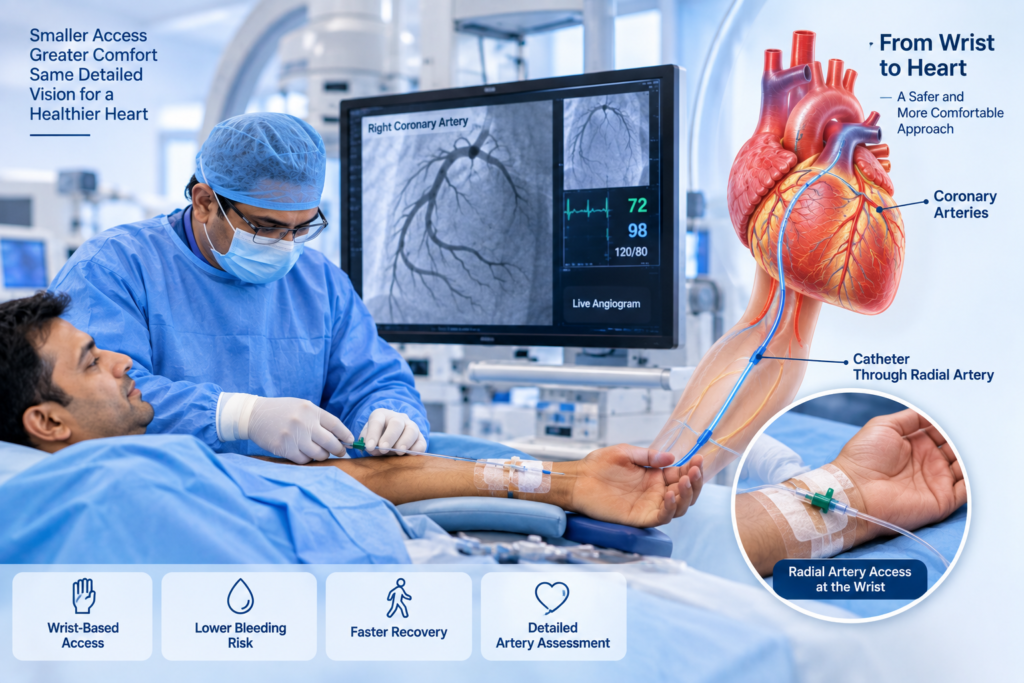
Radial angiography is a form of coronary angiography in which the cardiologist accesses the coronary arteries through the radial artery in the wrist, rather than using the femoral artery in the groin. A thin catheter is guided through the blood vessel toward the heart, and contrast dye is used to create detailed X-ray images of the coronary arteries.
The procedure can help identify narrowed or blocked coronary arteries and provide important information for deciding the next step in treatment. Depending on the findings, the cardiologist may recommend medication, further evaluation, angioplasty and stenting, or another appropriate treatment.
Radial access has become an established approach for coronary angiography and coronary intervention. Compared with femoral access, it is associated with lower bleeding and vascular access-site complications in appropriate patients.
For suitable patients, accessing the coronary arteries through the wrist may also allow earlier movement after the procedure and can support shorter post-procedure recovery in selected cases. However, the choice of access route depends on the patient’s anatomy, medical condition and the cardiologist’s clinical judgment.
Our Approach
Comprehensive Care at Every Step
Pre-Procedure Assessment
Your symptoms, medical history, medicines, allergies and relevant test results are reviewed before the procedure. The medical team determines whether radial access is suitable for you.
Wrist-Based Arterial Access
After local anaesthesia is given, a small access sheath is introduced through the radial artery at the wrist.
Coronary Artery Imaging
A thin catheter is guided toward the heart and contrast dye is injected while X-ray images are taken to assess the coronary arteries.
Detailed Blockage Assessment
The angiogram helps identify the location and severity of narrowing or blockage in the coronary arteries.
Treatment Planning
The findings help the cardiologist decide whether medication, further testing, angioplasty and stenting, or another treatment approach is appropriate.
Post-Procedure Wrist Care
After the catheter is removed, pressure is applied to the wrist access site to control bleeding. The wrist and hand are monitored before discharge and follow-up instructions are provided.
What Happens During Radial Angiography?

Dr. Himanshu Parashar
MBBS, MD(Medicine), DNB(Cardiology), MCSI, IAMACC(America)
Before the procedure, your cardiologist reviews your medical history, current medicines, allergies and relevant investigations. You may be given specific instructions about eating, drinking and medications depending on your condition and the planned procedure.
During radial angiography, you lie comfortably on an X-ray table. The wrist area is cleaned and numbed with local anaesthetic. A small tube called a sheath is then inserted into the radial artery, through which the catheter is carefully guided toward the heart.
Contrast dye is injected through the catheter while X-ray images are taken. You may briefly experience a warm sensation when the contrast is injected. The cardiology team monitors you throughout the procedure and takes images from different angles to assess the coronary arteries.
Once the angiography is complete, the catheter and sheath are removed. A compression device or dressing is applied to the wrist to control bleeding. Your wrist, hand circulation and overall condition are monitored before you are discharged or transferred for further care.
Radial Angiography – Frequently Asked Questions
When is radial angiography recommended?
Radial angiography may be recommended when detailed assessment of the coronary arteries is required and the radial artery is considered an appropriate access route. It may be used for patients being evaluated for coronary artery disease and in selected patients requiring coronary intervention.
Why is the wrist used for angiography?
The radial artery at the wrist provides an alternative access route to the coronary arteries. Compared with femoral access through the groin, radial access is associated with lower bleeding and vascular access-site complications in appropriate patients.
How is radial angiography performed?
After local anaesthesia, a small sheath is inserted into the radial artery at the wrist. A catheter is guided toward the heart under X-ray guidance, and contrast dye is injected to visualize the coronary arteries.
Do I need to prepare before radial angiography?
Preparation depends on your health condition, medicines and the type of procedure planned. Your medical team may review your medications, allergies, kidney function and other relevant factors and provide specific instructions before the procedure.
What are the benefits of radial angiography?
Radial access can reduce bleeding and access-site vascular complications compared with femoral access in appropriate patients. It can also allow earlier movement after the procedure and may support earlier discharge in selected patients.
Our Location
Expert Cardiac Care Near You
- Monday to Saturday
- 10 AM to 4 PM
Supporting Better Heart Health.
Book a Cardiology Consultation